
Make Love Not War
I was going to blip an old church marooned in the fields when a road was rerouted 200 years ago. That was nice but then I walked on into the remote 'misfit' valley that lies beyond (so-called for being a wide glacier-formed valley with now only a small stream running through it) - and I found something of far greater interest to me.
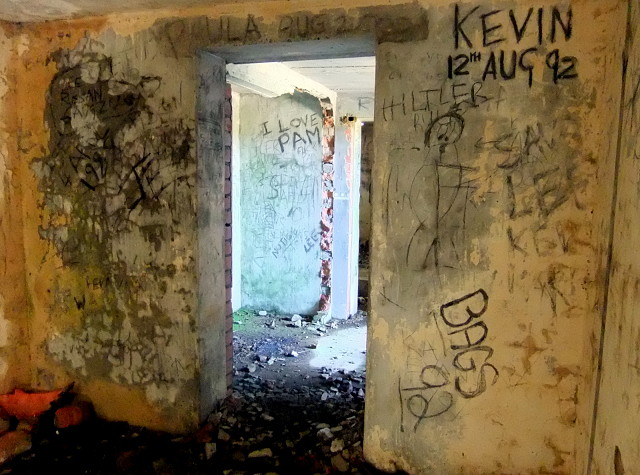
Amid the gorse and briars a dark concrete mouth revealed an underground wartime bunker, sunk into the side of the valley. Considerably larger than the pillbox I blipped a while ago, this structure had three intact 'rooms' one with access via a ladder, now gone, to the surface.
The significance of the location immediately dawned on me because this empty valley neighbours another in which a crucial munitions depot processed naval armaments right through the war. Many local people were employed there but even now the details remain hush-hush. My old friend and local informant who worked there reminds me, when I pump him for information, that he is still, over 60 years later, bound by the Official Secrets Act. However he did tell me that this valley served as a decoy for the real one. It's not clear how, but local people talk of seeing structures erected, with lights, all along the swampy valley bottom - to act like wreckers' lamps luring to a fake target. But no lives were lost, no planes were downed. He tells me
"The Luftwaffe searched for it but they never found the bomb store."
I'm certain that this bunker must have been part of that defence scheme. Now there's rubble on the floor and it's damp and musty; a palimpsest of graffiti scribble betrays its use by local kids as somewhere to take drugs and have sex (or to talk about it!) - I found dates back as far as 1964. I wonder what has happened to Pam? Although the place is hardly ideal for a romantic assignation it is not unsavoury and the valley is very peaceful now.
[Story about an injured swallow removed in the interests of brevity.]
Update.
I've discovered that this is a control bunker for a naval bombing decoy site. The sites normally had a control bunker protected by a blast wall at the entrance, a small corridor separated two rooms, one for the generator & one for the control room to operate switchgear for fires & lights, also an observation/escape hatch in the roof.
The bunker would be manned continuously by two, probably civilian, personnel who would be informed by phone if enemy planes were on their way. The decoy lights and fires would be activated at a carefully calculated moment to deflect the bombing from the genuine target and then to give the appearance that it had been hit. Such decoys were placed adjacent to sites which might be the object of enemy action for example harbours, aerodromes and factories. Some of the decoys were very elaborate in their construction so as to give convincing false impressions.
'The decoys used a number of special effects to achieve their aims, for example: lighting would be laid out in the shape of streets (or runways as appropriate), and left on until attackers had a chance to see them from a distance, then extinguished as if in response to an air raid warning. The real area would have been blacked out well in advance, thanks to advance warning by Britain's closely guarded secret radar system, and sightings reported by the Observer Corps. Flash bombs would be detonated to simulate tram power lines arcing, and the Starfish sites would ignite various forms of controlled fire, laid out to simulate the plan view of shipyards and production facilities, which again would have been blacked out in advance of the attacker's arrival. The fires could be relatively simple fuels pools, ignited as required; fire baskets containing materials soaked in an mixture oil and pitch; and more sophisticated burners, where burning oil and water could be mixed, resulting in a brilliant flare as the water changes to steam and expands rapidly, converting the dense, slow-burning fuel oil into a fast-burning mist.'
There's some examples here from the north of England and elsewhere [link lost] there a description of the whole decoy operation.
As far as I know this decoy was never deployed but a couple of blokes must have sat the war out here waiting at the ready for the telephone call that never came. They were provided with a small stove and presumably would have had an endless supply of tea and cigarettes. The bunker would have provided them with protection if the strategy succeeded and the false target had been subject to enemy bombardment (although the external blast wall in front of the entrance no longer exists.)
Comments
Sign in or get an account to comment.


